

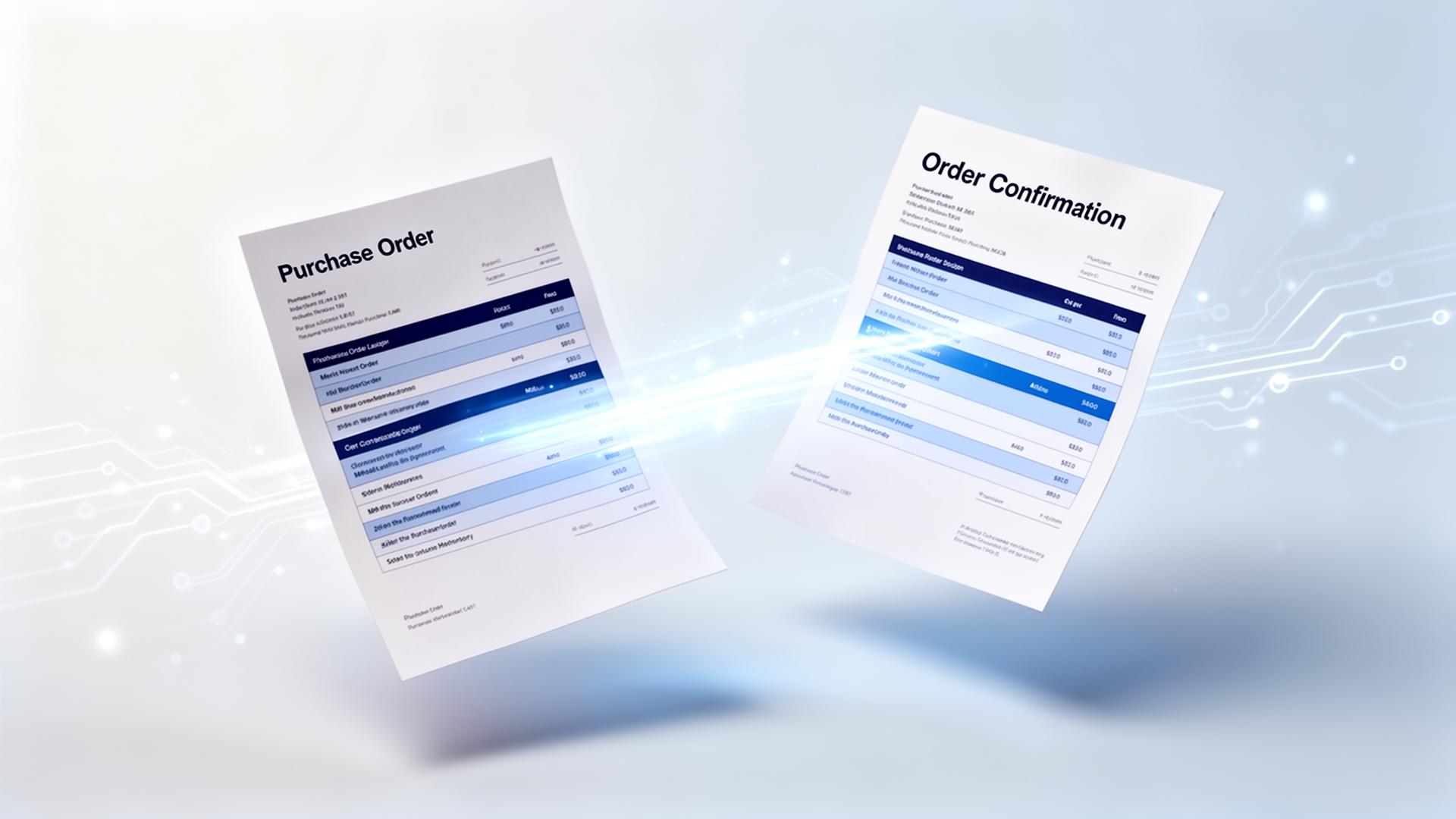
Procurement teams receive dozens of order confirmations from suppliers every day, in PDF, email or via portals. Anyone comparing them manually against the original purchase order will miss small deviations in price, quantity or delivery date. Those errors only surface downstream: at goods receipt, at invoicing, or worst of all in production planning. AI-driven matching compares order confirmation and purchase order line by line and flags every deviation while you can still do something about it.
What is automated order confirmation matching?
Automated order confirmation matching means every incoming supplier confirmation is read automatically and compared line by line against the original purchase order in your ERP. Generative AI does this without fixed templates, even for suppliers that send confirmations in free-form layouts.
A modern solution covers the full matching chain:
- Intake of confirmations from shared mailboxes, supplier portals and EDI.
- Extraction of supplier, PO number, items, quantities, prices and delivery dates.
- Linking to the right purchase order in SAP, Exact, AFAS, Microsoft Dynamics or Navision.
- Line-by-line matching with tolerance limits on price, quantity and date.
- Flagging deviations with a clear marker, suggestion and root cause.
For a procurement manager this means errors on the confirmation are caught before they enter the supply chain, not at goods receipt or invoicing, where correction becomes expensive and painful.
Which order confirmation deviations does AI solve?
Almost every procurement team recognizes them: small changes a supplier "just mentions" in the confirmation but no one actively checks. AI catches all of them automatically.
- Price deviations: the confirmed price differs from the contracted price or the price on the PO. One euro per unit sounds small, but at 10,000 units it adds up fast.
- Quantity and unit-of-measure mismatches: supplier confirms 950 instead of 1,000, or confirms in cases where you ordered in pieces. Production stops if it goes unnoticed.
- Shifted delivery dates: the confirmed delivery week is two weeks later than requested. Without early signaling planning only finds out when the goods fail to arrive.
- Substituted item numbers: supplier confirms an alternative item ("substitute") without explicit alignment with procurement or engineering.
- Partial deliveries: the confirmation splits your order into multiple part-deliveries with different dates, while your ERP still expects a single delivery.
Each of these is a deviation you would rather see now, not when goods receipt or invoicing grinds to a halt.
What does an automated matching flow look like in practice?
A typical matching flow replaces 5-10 minutes of manual comparison per confirmation with a few seconds of AI processing. Step by step:
- Order confirmation arrives in a shared mailbox (e.g. purchasing@company.com) as PDF, scan, Excel or in the body of an email.
- AI extracts the confirmation and recognizes supplier, PO number, items, quantities, prices and delivery dates, even from suppliers with their own item codes.
- Linking to the purchase order in your ERP via the PO number, or via supplier + item + date when the PO number is missing.
- Line-by-line matching against the PO, with configurable tolerance limits (e.g. <1% price deviation auto-accept, >1% to review).
- Deviations to review: every deviation appears in one overview with original field, confirmed field and AI suggestion. Procurement approves, edits or emails the supplier with one click.
- Posting in ERP: approved confirmations automatically update the PO (date, price, quantity) so planning and finance work with current data.
Result: 70-85% of confirmations are matched without human intervention. Only the real deviations get attention, exactly on time.
| Aspect | Manual | With ENTR |
|---|---|---|
| Deviation detection | Spot checks, often only at goods receipt | 100% of lines, instantly on arrival |
| Time per confirmation | 5 to 10 minutes line-by-line | Seconds, only exceptions hit a human |
| Tolerance thresholds | Unwritten rules per buyer | Configurable per supplier and SKU |
| Late-delivery risk | High, date slips spotted too late | Early flagging, time to course-correct |
| Procurement workload | Reactive firefighting | Focus on exceptions and supplier relations |
Why is early signaling of deviations so important?
The cost of a missed deviation grows exponentially the further it travels through the chain. Whoever accepts a wrong confirmation pays the price weeks later, when correction is most expensive.
- At confirmation approval: correction is one email to the supplier. Negligible.
- At goods receipt: the receiving clerk has to investigate, block stock, arrange return transport. Hours of work per case.
- At invoicing: mismatch between PO, receipt and invoice (three-way match) leads to invoice blocks, payment disputes and manual corrections in finance.
- At production or onward delivery: wrong item or late delivery means production downtime, rush shipments or saying no to your own customer. Damage in tens of thousands of euros per case.
Early signaling at the confirmation is therefore not a "nice-to-have", it is the difference between a few minutes of correction and a disruption worth thousands.
What does automated matching deliver for procurement teams?
The impact is directly measurable, operationally and financially. Most procurement departments see improvement on every relevant KPI within a single quarter.
- Drastically fewer errors downstream: deviations are caught at the source. Goods receipt and finance handle far fewer exceptions.
- Faster lead time: confirmations are processed in minutes instead of sitting for days. Planning works with current delivery dates.
- Margin protection: every price deviation is detected and can be raised with the supplier before delivery. No more "silent" price increases.
- Fewer invoice blocks: because PO and confirmation are already matched, the three-way match at invoicing flows through far more often.
- Scalability: 30-50% more procurement volume does not require 30-50% more capacity. The team keeps time for supplier management and strategic sourcing.
- Audit trail and compliance: every deviation is logged with date, decision and handler, essential for ISO audits and internal control.
How do you handle supplier-specific agreements and tolerances?
Not every deviation is a problem. A 0.5% price deviation on a commodity is fine; with a strategic supplier you want to check every cent. AI applies supplier-specific rules so only relevant deviations are flagged.
Examples of rules you can set per supplier or item group:
- Price tolerance (e.g. <1% auto-accept, >1% review, >5% immediate escalation).
- Date tolerance (e.g. 2 days earlier/later acceptable, beyond that flag).
- Accept under-delivery within X% (e.g. for custom or natural products).
- Allow alternative items only after explicit engineering approval.
- Translate supplier item codes automatically to your own item number.
The system learns from every correction. A deviation you approve three times gets placed within tolerance on the fourth, without manual rule tweaking.
How do you measure the success of automated matching?
Steer on a handful of KPIs tied directly to procurement and supply chain performance. Most organizations see measurable improvement within 4-8 weeks.
Operational KPIs
- Auto-match rate: share of confirmations matched without human intervention. Aim for 70-85%.
- Processing time per confirmation: from arrival to ERP processing. Goal: from 5-10 minutes down to under a minute on average.
- Signal rate: share of deviations caught at confirmation versus only later in the chain. Aim for >90%.
Financial and supply chain KPIs
- Invoice blocks: drop in three-way match mismatches.
- Avoided price increases: total value of blocked or reversed price hikes.
- OTIF towards your own customers: fewer disruptions caused by late-detected delays.
- Capacity for growth: can you handle 20-50% more procurement volume without extra FTE?
How do you get started with automated order confirmation matching?
As with any AI rollout the golden rule is: start small, learn fast, scale after. A phased 6-8 week pilot on a limited supplier group is the proven approach.
- Pick 5-10 suppliers that are representative, for instance your top suppliers by volume or the suppliers with the most historical deviations.
- Map the current flow: where do confirmations arrive, who checks them today, how many deviations are missed?
- Define tolerance limits per supplier or item group together with procurement, finance and planning.
- Run in parallel: let the AI shadow for 2-4 weeks without updates going straight to the ERP, so the team builds confidence.
- Enable auto-match for confirmations within tolerance. Route deviations through the review screen.
- Scale up to more suppliers, more item groups and eventually the full procurement stream, including the link to the three-way match.
Most organizations have 70%+ of order confirmations auto-matched within a single quarter, without large upfront investment thanks to pay-per-use pricing.
Frequently asked questions
Does AI matching work when suppliers do not put a PO number on the confirmation?
Yes. The AI prefers to link by PO number but falls back to a combination of supplier, item number, quantity and order date when the PO number is missing or unreadable. In practice >95% of confirmations are correctly linked to the right purchase order, even with suppliers using non-standard reference fields.
How does the AI handle partial and split deliveries?
The AI recognizes multiple delivery dates per line and automatically splits the confirmation into part-confirmations, each linked to the correct PO line. Your planning sees exactly which part arrives when, without procurement having to split manually in the ERP.
Will AI replace my buyers?
No. AI replaces the mechanical comparison and only flags what needs attention. Your buyers get time for the work where they add real value: supplier conversations, contract negotiations, sourcing and strategic supply chain management. In practice the procurement organization grows in impact rather than in size.
Can AI matching connect to our existing SAP, Exact, AFAS or Microsoft Dynamics?
Yes. Modern AI platforms connect via standard APIs to SAP, Exact Online, Exact Globe, Microsoft Dynamics 365 Business Central, AFAS, Navision, Unit4 and most industry-specific ERPs. Purchase orders are read and updates (date, price, quantity) are written with the correct fields, authorization and audit trail.
What happens if the AI misinterprets a deviation?
Every match gets a per-field confidence score. When in doubt the confirmation lands in a review screen with the AI interpretation next to the original confirmation and the PO, so procurement can approve or correct in seconds. Every correction makes the AI better for future confirmations from that supplier.
How does automated matching relate to a three-way match in my ERP?
Automated matching of confirmation against PO is the preparation for a successful three-way match. Because deviations are caught or recorded at the confirmation stage, the match between PO, receipt and invoice flows through far more often. The share of blocked invoices typically drops 40-70%.
What does it cost and how fast does it pay back?
Modern platforms use pay-per-use: you pay per processed confirmation, no fixed license fees. For most procurement departments payback lands at 3-6 months, based on saved hours, avoided price increases and fewer disruptions downstream.