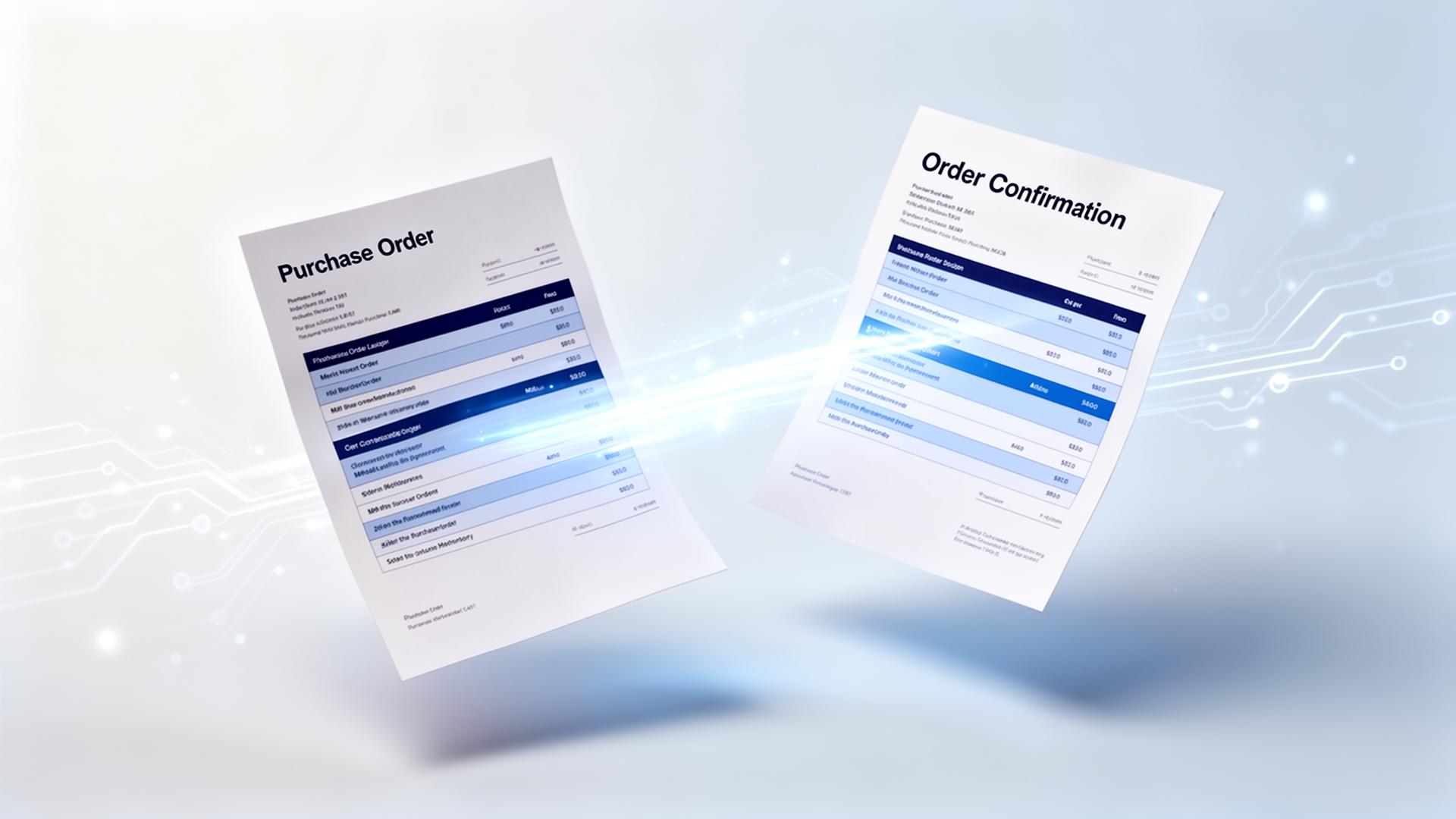


Manual sales order entry is a silent bottleneck that prevents manufacturers and wholesalers from scaling. By implementing AI for sales order processing, companies can move from manual typing to exception-based management, reclaiming hundreds of hours per month.
The hidden cost of manual order entry
Most operations managers view order entry as a necessary cost of doing business. However, the true cost extends beyond the salary of internal sales teams. It includes the price of data entry errors, the delay in production scheduling, and the opportunity cost of having skilled employees act as human copy-paste machines.
When orders arrive via PDF or email, the time-to-ERP often stretches from hours to days. This lag ripples through the supply chain, affecting inventory accuracy and customer satisfaction.
How GenAI differs from traditional OCR
For years, manufacturers tried to solve this with Optical Character Recognition (OCR). The results were often disappointing because OCR relies on rigid templates. If a customer changed their document layout by one millimeter, the system failed.
Modern AI for sales order processing uses Large Language Models (LLMs) to understand the context of an order. It doesn't just see text; it understands which string is a Part Number, which is a Quantity, and which is a shipping instruction, regardless of the document format.
Key benefits of automating the sales cycle
- Reduced Lead Times: Orders reach the production floor or warehouse minutes after they arrive in the inbox.
- Data Integrity: AI eliminates the typos that lead to wrong shipments and costly returns.
- Scalability: Handle 2x or 3x the order volume during peak seasons without hiring temporary staff.
Integrating AI with your existing ERP
Automation should not require a complete overhaul of your IT infrastructure. The most effective AI solutions sit between your communication channels (email, EDI, portals) and your ERP (SAP, Microsoft Dynamics, AFAS, or Exact). The AI extracts the data, validates it against your master data, and pushes a clean sales order into the ERP for final approval.
| Aspect | Manual / status quo | With ENTR |
|---|---|---|
| Processing Time | 5-15 minutes per order | Under 30 seconds |
| Accuracy Rate | 90-95% (human error prone) | 99%+ with validation |
| Scalability | Requires more headcount | Infinite elastic capacity |
| Data Validation | Manual check against ERP | Automated SKU/Price lookup |
| Employee Morale | Repetitive, boring tasks | Focus on customer service |
Moving to exception-based processing
The goal of AI for sales order processing is not to remove the human entirely, but to change their role. Instead of entering every line item, your team becomes "Exception Managers." They only intervene when the AI flags a discrepancy, such as a price mismatch or an unrecognized SKU. This ensures 100% control with 90% less effort.
Implementing AI for sales order processing is no longer a futuristic luxury; it is a baseline requirement for manufacturers and wholesalers looking to maintain margins in a competitive European market.