
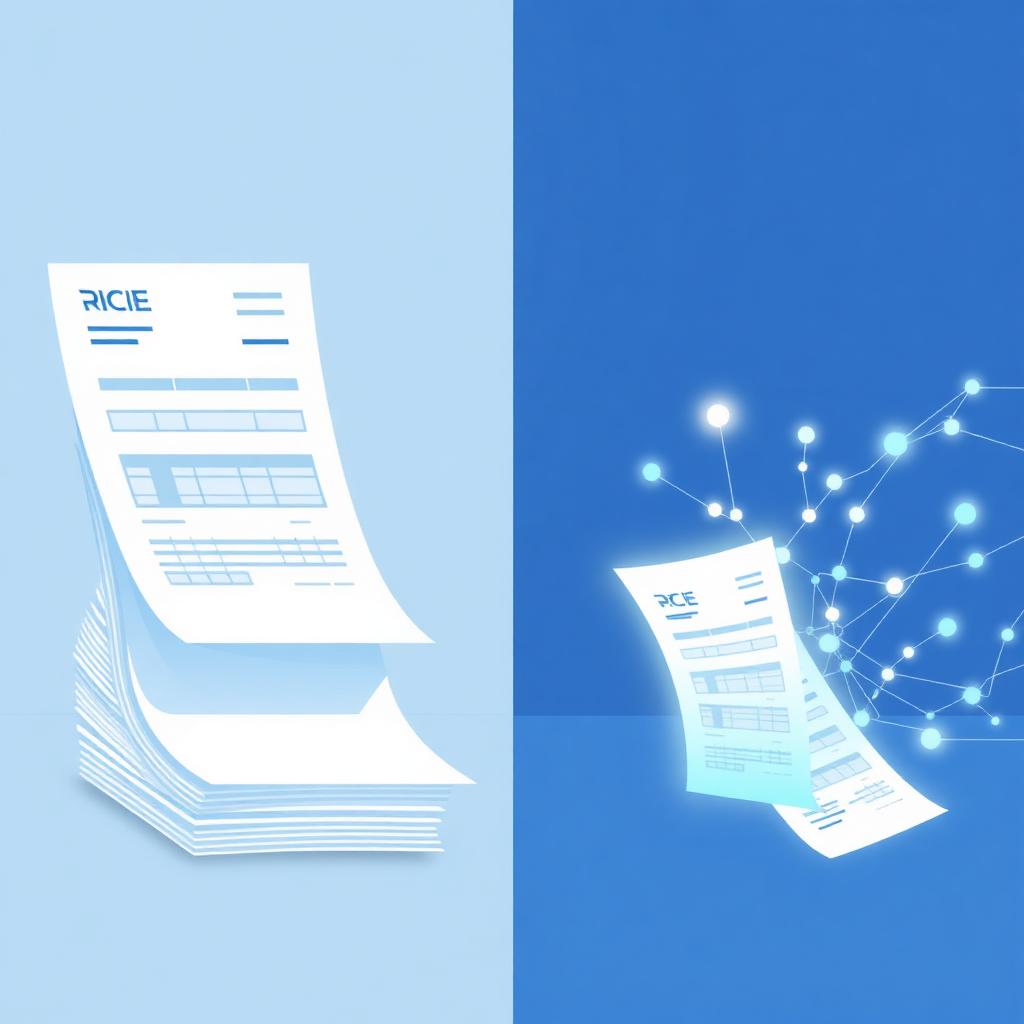
OCR-based invoice processing has been around for 20+ years and is still the default in most finance departments. But now that Generative AI can read and understand documents, the comparison is shifting. This article puts OCR (Klippa, Rossum, Basware, Scan Sys) and GenAI (ENTR) side by side on the aspects that actually matter in production, and shows how De Mors and NMQ Digital score on them.
Why OCR tools are still popular
Traditional OCR (Optical Character Recognition) has grown into a mature market. The big vendors ship polished dashboards, ERP connectors and years of feature refinement. For teams that want to convert large volumes of invoice images into text, that is attractive.
The downside: OCR is fundamentally pattern recognition. It recognizes characters and zones, not meaning. Every supplier with a different layout is effectively a new template, explicit or "auto-trained". That works for large, stable supplier bases, but breaks down on variation, new suppliers and additional languages.
What GenAI changes in invoice processing
Generative AI reads an invoice the way a human does: from context. Where OCR looks for "total amount in the bottom-right corner", an LLM understands that "Please pay by 30/08" is the same as "Amount due". That removes templates entirely and lets new suppliers land at high accuracy from day one.
More importantly, GenAI applies business rules in natural language. "Post invoices from supplier X to ledger 4210 by default, unless the reference contains a project code", that is a plain-English instruction, not a script.
| Aspect | Traditional OCR | With ENTR (GenAI) |
|---|---|---|
| Per-supplier templates | Yes, train or map per layout | No, template-free from invoice 1 |
| Accuracy on new suppliers | Low, often <70% without training | High, 90%+ on header fields out of the box |
| Line-item extraction | Brittle on non-standard tables | Robust, even with merged rows and page breaks |
| Business rules | Rule engine with technical config | Natural language: "if …, post to …" |
| Languages & formats | Train per language | Multi-language and multi-format out of the box |
| Time-to-value | 3 to 6 months implementation | 2 to 4 weeks live per flow |
| Pricing model | License + implementation + per document | Pay-per-use, no setup fee |
The 5 biggest advantages of GenAI invoice processing
- No more templates. New suppliers work from the first invoice, no waiting for training or mapping.
- Higher first-time-right ratio. Because context is understood, fewer invoices go to manual review.
- Policy in plain language. Finance owns the rules, no IT ticket needed for an exception.
- Fast time-to-value. Live in weeks instead of months, on pay-per-use instead of a large license contract.
- Moves with your organization. New ledgers, cost centers or suppliers only need a text update to the rules.
Case: De Mors, supplier invoices into ECI Proteus
De Mors is a respected Dutch construction company and part of VolkerWessels. The Finance Administration processes large volumes of supplier invoices every day that need to land in ECI Proteus without errors. With OCR the team kept correcting manually because every contractor and supplier uses a different layout. With ENTR the header fields are reliably extracted from day one, including confidence scores. The next step is splitting cost at invoice line level for sharper project insight.
"The Gen AI tool we source through ENTR aligns perfectly with our ambitions and genuinely moves us forward.", Jacco Kettelarij, IT Manager, De Mors
Read the full De Mors case study →
Case: NMQ Digital, invoices across continents
NMQ Digital is a digital marketing agency serving clients like Philips, Rituals and Sony, with teams spread across Europe, South America and Asia. Invoices arrive in multiple languages, currencies and layouts. With a traditional OCR flow that becomes a template nightmare. ENTR processes the entire stream template-free, applies business rules per entity and posts directly into the finance system.
Read the full NMQ Digital case study →
When is OCR still good enough?
If you have 5 stable suppliers on identical layouts, little line-item work and an OCR license already paid for, the case to switch is small. As soon as you deal with supplier variation, multiple languages, project coding or line splits, OCR starts costing money in the form of rework and slow throughput.
How ENTR handles invoice processing
- Intake in a central mailbox or via API.
- Extraction of header and line fields with GenAI, including confidence per field.
- Validation against natural-language business rules (supplier → ledger, project, VAT).
- Posting into Proteus, Exact, SAP, Dynamics or Business Central via the standard connector.
- Review only on deviations, everything else clears itself.
Frequently asked questions
Isn't GenAI more expensive than OCR?
Per document, ENTR sits in the same range as modern OCR platforms. There is a one-time implementation fee to set up the flow and integrations, but because there is no template maintenance and you go live quickly, real-world TCO tends to be lower.
Does this scale to large volumes?
Yes. Both De Mors and NMQ process thousands of invoices per month through ENTR.
What if the AI gets it wrong?
Every posting has a confidence score. Below a threshold, the document goes to a review queue with the source document alongside, nothing is posted until it is approved.