

Manufacturing operations often stall at the desk of the sales coordinator. While production lines are automated, the influx of PDFs, Excel sheets, and handwritten scans remains a manual bottleneck. Intelligent Document Processing (IDP) changes this by moving beyond simple text recognition to actual document understanding.
The limitation of traditional OCR in manufacturing
For years, manufacturers relied on Optical Character Recognition (OCR). The problem? OCR is brittle. It relies on templates. If a customer changes their PO layout by two millimeters, the system breaks. In a sector where every customer has a unique format and product codes vary by a single digit, template-based systems create more work than they save.
Intelligent Document Processing uses GenAI to interpret context. It doesn't just see text; it understands that 'SKU-99' in a header is a product identifier and 'Qty' refers to the volume. This eliminates the need for constant template maintenance.
Automating complex line items and BOMs
The biggest challenge in manufacturing is the complexity of line items. A single purchase order might contain dozens of rows, each with specific configurations, delivery dates, and technical specifications. Manually re-keying these into an ERP system like SAP or Microsoft Dynamics is high-risk work.
- Contextual Mapping: IDP matches customer-specific part numbers to your internal database automatically.
- Unit Conversion: The system recognizes if a customer orders in 'pallets' while your system records 'units'.
- Validation: AI checks if prices on the PO match the current price lists in your ERP.
Reducing the 'Order-to-Cash' cycle
Every hour spent on manual data entry is an hour added to your lead time. When sales orders are processed instantly via IDP, the production floor receives requirements faster. This agility is a competitive advantage in the EU market, where customers demand shorter lead times and higher transparency.
| Aspect | Manual / status quo | With ENTR |
|---|---|---|
| Processing Time | 10-20 minutes per order | Seconds per document |
| Data Accuracy | Human error risk (3-5%) | 99%+ with AI verification |
| Scalability | Hire more staff to grow | Scale volume without new hires |
| ERP Integration | Manual copy-paste | Direct automated sync |
| Complex Tables | Tedious manual entry | Instant line-item extraction |
Improving supplier relations in purchasing
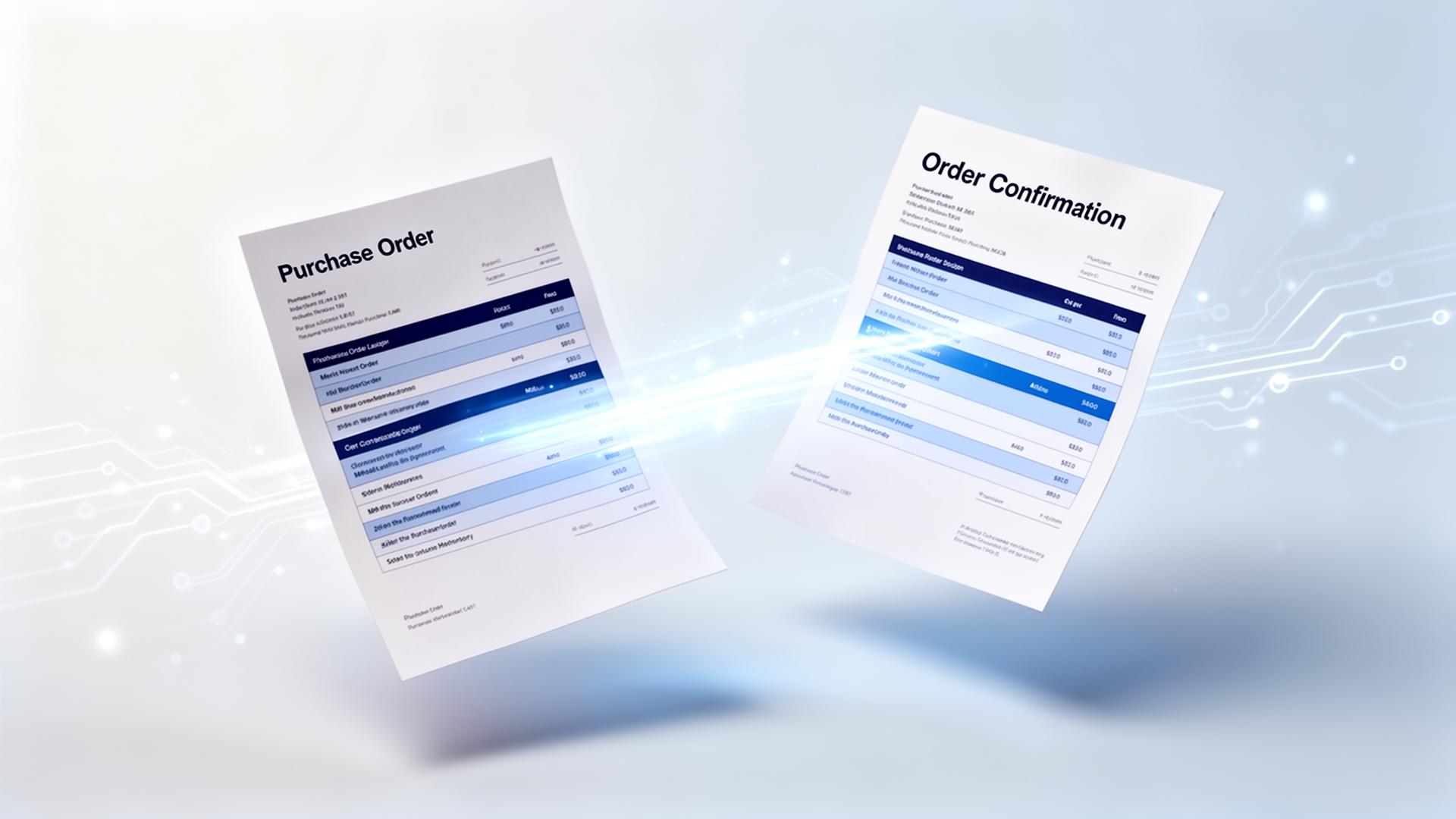
IDP isn't just for sales. Purchasing departments use it to handle order confirmations and packing slips. When a supplier confirms an order, the AI automatically checks if the quantities and dates match your original Purchase Order. If there is a discrepancy, the system flags it immediately, preventing downstream production delays.
Selecting the right IDP solution
When evaluating IDP for manufacturing, focus on three criteria: the ability to handle non-standard layouts, the speed of integration with your existing ERP, and the user interface for your team. The goal is not to remove the human entirely, but to provide them with a 'Human-in-the-loop' interface where they only need to click 'approve' rather than typing data.
By implementing IDP, manufacturers typically see a 70-90% reduction in manual processing time. This allows your team to focus on customer service and strategic procurement rather than administrative data entry.